Home / Article
Voice and Video Edge Appliances Are CMMC Boundary Evidence
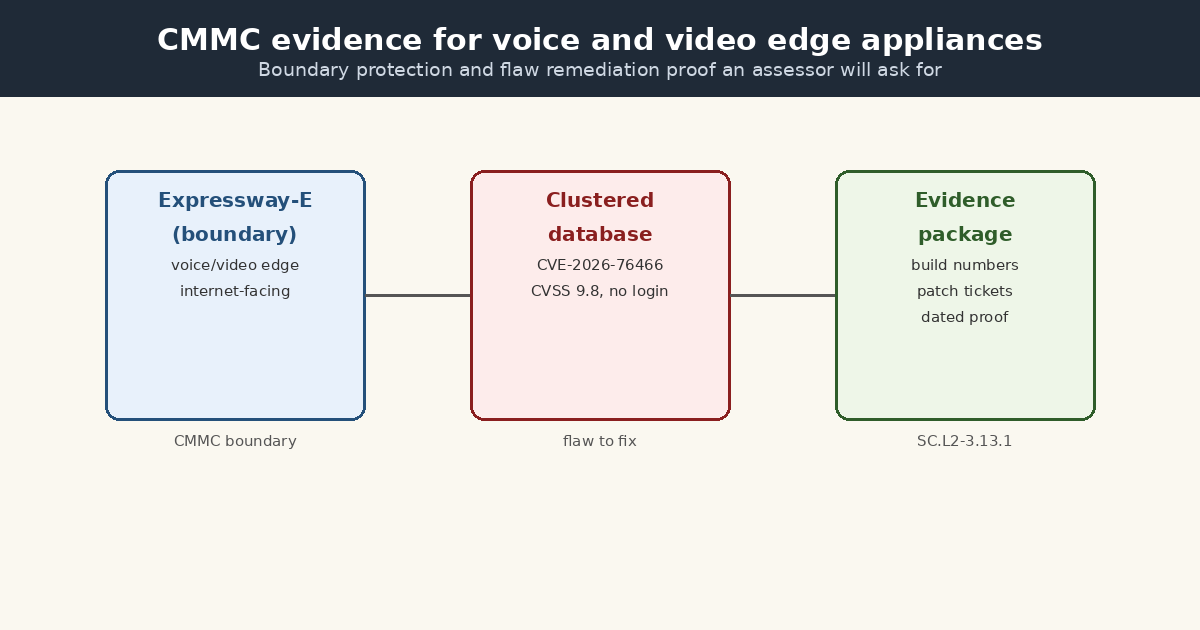
Cybersecurity Maturity Model Certification (CMMC) asks for proof, not intent. A voice appliance in the DMZ (demilitarized zone) is part of that proof.
Cisco published hardening releases on October 21, 2026. The worst flaw needs no login. It gives a remote attacker root on clustered Expressway.
The Expressway flaw assessors will ask about
The record is CVE-2026-76466. Common Vulnerabilities and Exposures (CVE) is the record system.
Cisco Expressway-E sits at the edge on purpose. It lets remote staff reach internal voice and video without a VPN (virtual private network). That placement makes it a prime target.
The flaw is in the database service of clustered Expressway-C and Expressway-E. Persistent cookies combine with weak TLS (Transport Layer Security) client certificate checks. An unauthenticated remote attacker can invoke RPC (remote procedure call) commands. The result is OS (operating system) commands as root.
Cisco scores it 9.8. The fix is X15.5.20. Cisco lists no workaround. Cisco knows of no malicious use as of October 21, 2026.
The Unified CM batch beside it
A second advisory hardens the voice products. It carries eight CVEs. Two score 9.8: CVE-2026-76473 and CVE-2026-76474. CVE-2026-76475 scores 9.3.
Affected products include Emergency Responder and Prime Collaboration Deployment. They also include Unified CM, Unified CM IM and Presence, Unified CM Session Management Edition, and Unity Connection. The fix is release 15SU5.
Which CMMC practices this touches
Practice SC.L2-3.13.1 covers boundary protection. You must monitor communications at external boundaries. Expressway-E sits on that exact boundary.
Practice SI.L2-3.14.1 covers flaw remediation. You must identify, report, and correct flaws in a timely way. A 9.8 with no workaround is the test case.
Your evidence should link each practice to proof. Show the appliance inventory with build numbers. Show the patch ticket with before and after versions. Show the scan that found the flaw and the scan that confirmed the fix.
PolicyCortex does not patch Cisco products. Your team applies vendor fixes. PolicyCortex helps organize the evidence that follows.
What to do this week
List every Expressway and Unified CM node in your boundary. Record the version and cluster status. Patch to X15.5.20 and 15SU5 and save the dated proof.
Sources
- CVE-2026-76466 record, CVE Program.
- Cisco Security Advisory cisco-sa-vcs-static-cred-hr7EWZ8t, Cisco Expressway Series Remote Code Execution Vulnerability, October 21, 2026. https://sec.cloudapps.cisco.com/security/center/content/CiscoSecurityAdvisory/cisco-sa-vcs-static-cred-hr7EWZ8t
- Cisco Security Advisory cisco-sa-voice-hardening-twgbH9e3, Cisco Unified Communications Products Security Hardening Release: October 2026, October 21, 2026. https://sec.cloudapps.cisco.com/security/center/content/CiscoSecurityAdvisory/cisco-sa-voice-hardening-twgbH9e3
- Original diagram by PolicyCortex.
Next step
Want boundary and patch evidence linked to each practice? See how PolicyCortex collects it from live systems.