Home / Article
cPGuard Compromise: Supply Chain Risk and System Inventory
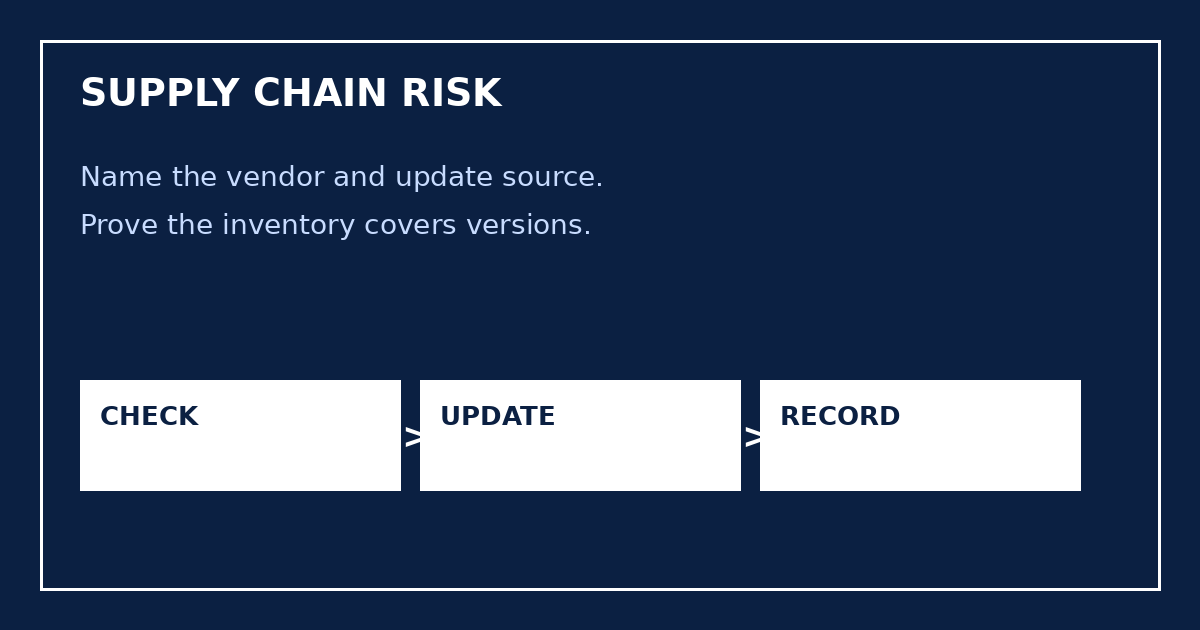
Supply chain risk lives in the update path, not only in the purchase order. This cPGuard event proves that point in plain terms.
What happened
OPSSHIELD reports a malicious script in cPGuard updates 5.88.12 through 5.88.19. On 2 November 2026 at 02:06 UTC, an attacker used compromised credentials. The attacker reached OPSSHIELD update distribution infrastructure. That infrastructure is a content delivery network (CDN). The attacker sent the script through the cPGuard update channel. OPSSHIELD detected the compromise within 12 hours. How the attacker obtained the credentials remains under investigation.
The inventory question
A system inventory must name each server and its software source. It must name cPGuard as a component on each server that runs it. It must record the version on each server, by date. It must record the update channel that delivered that version. Without that detail, a team cannot scope an update channel event. With that detail, the team can list affected servers in one pass. The script collected password files and database settings. It collected shell history and Secure Shell (SSH) files. Those collections raise the risk rating for each affected server.
The risk record
First, list each server that runs cPGuard, with its version. Second, flag versions 5.88.12 through 5.88.19 as affected. Third, check each server for the listed indicators. Fourth, record the move to version 5.88.25 or later. Fifth, record each rotation of passwords, keys, and tokens. OPSSHIELD estimates 32 collected files were retrieved. Each file corresponded to one customer server. That figure is preliminary, not a total count of affected servers. Treat the vendor advisory as the risk source, not as your own scope.
What to do this week
Run the cpgcli update command with the start option. Confirm the cpgcli version reads 5.88.25 or later. Reset root passwords from a trusted recovery environment. Rotate database passwords, cloud storage keys, and tokens. Replace private keys in /root/.ssh and remove old public keys. File the vendor notice, the version list, and the rotation record together.
PolicyCortex does not clean compromised servers. PolicyCortex helps teams link proof to requirements.
Sources
- OPSSHIELD advisory, cPGuard update channel compromise. https://opsshield.com/notice/cpguard-update-channel-compromise.html
- Cybersecurity News coverage, November 3, 2026. https://cybersecuritynews.com/cpguard-supply-chain-attack/
- SecurityOnline coverage, November 3, 2026. https://securityonline.info/cpguard-supply-chain-attack/
- Original diagram by PolicyCortex
Next step
Name the vendor update channel on every server record in the inventory.