Home / Article
Drupal Commerce Flaw: Access Control Evidence for CMMC
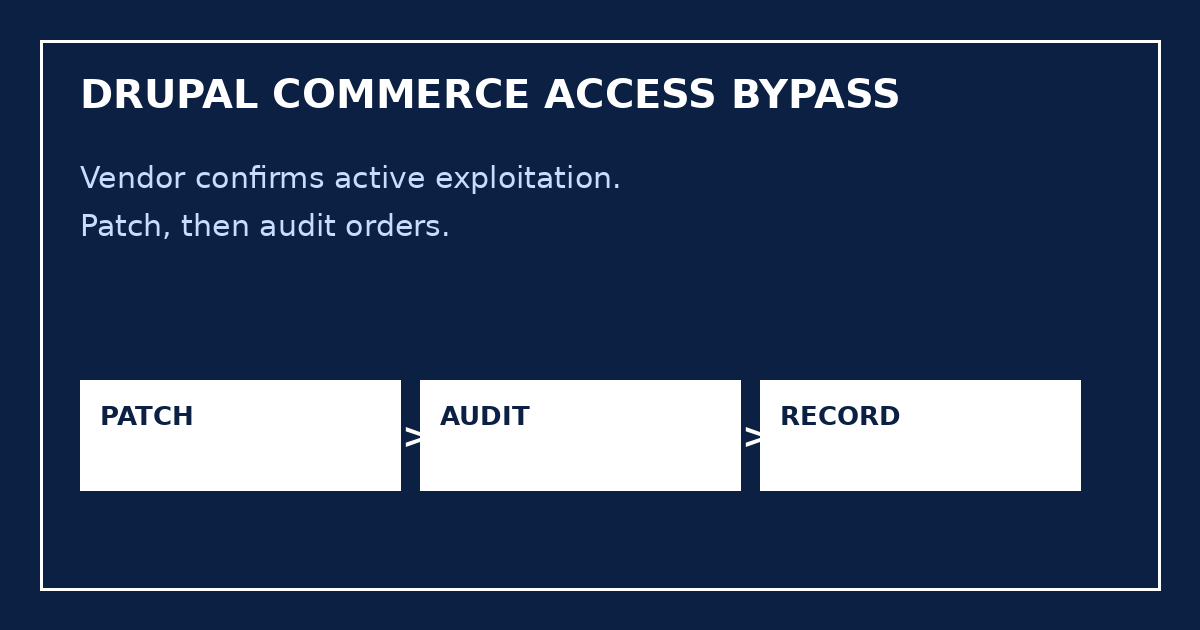
An assessor will test access control claims first. A commerce flaw that bypasses checks is the test case. Your evidence must prove enforcement, not just intent.
The flaw in plain words
Drupal published advisory SA-CONTRIB-2026-254 on October 28, 2026. Drupal calls the flaw Highly critical. Commerce Core sells goods and services through a cart and checkout. Some routes and entity fields lack enough protection. That gap lets an attacker bypass access checks. The record is CVE-2026-118539. The flaw carries a public record in the Common Vulnerabilities and Exposures (CVE) system. No login is needed to reach the protected routes and fields. Drupal states the flaw is actively exploited in the wild. Fixed releases are Commerce Core 3.3.13 and 8.x-2.41.
What the evidence must show
First, the list of systems that run Commerce Core. Second, the installed release on each system. Third, the fixed release and the patch date for each system. Fourth, proof that the new release is actually running. A version note alone is a weak claim. Add a scan result or a release check after the patch. Fifth, the order audit result for each system. Orders are the records that show abuse or its absence. Record who ran the audit and when it ran.
What is not confirmed
Drupal names no attacker in its advisory. It gives no victim count and no attack volume. It does not claim a full site takeover. Do not inflate the impact in your evidence. An inflated claim weakens trust in the whole file.
PolicyCortex does not patch Drupal modules. PolicyCortex helps teams link proof to requirements.
Sources
- CVE-2026-118539 record, CVE Program
- Drupal security advisory SA-CONTRIB-2026-254, October 28, 2026. https://www.drupal.org/sa-contrib-2026-254
- Original diagram by PolicyCortex
Next step
Record the fixed release and the audit result for each commerce system.