Home / Article
How Do We Hash Our Evidence Artifacts for a CMMC Assessment?
Your assessor will ask one hard question about your files. Did this file change after you collected it? A hash answers that question with proof, not trust.
CMMC means Cybersecurity Maturity Model Certification. C3PAO means CMMC Third-Party Assessment Organization. A hash is a short fixed length code made from a file. SHA means Secure Hash Algorithm. FIPS means Federal Information Processing Standards.
What a hash does
A hash function reads a file and makes a code from its bytes. Change one byte and the code changes completely. The code does not reveal the file contents. Anyone with the same file and the same algorithm gets the same code. That is why a hash proves a file stayed the same.
Which algorithm to use
Use SHA-256 for new evidence work. FIPS 180-4 names SHA-256 as an approved hash function. SHA-384 and SHA-512 are also approved choices. SHA-1 is no longer a safe choice for proof. NIST decided in 2023 to remove SHA-1 from the standard. MD5 is broken for this purpose and must not be used. Pick one algorithm and use it for the whole set.
How to hash evidence in four steps
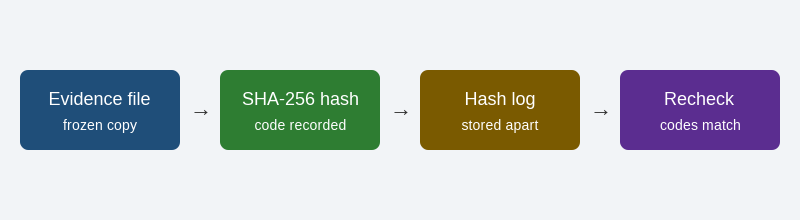
First, collect the file and freeze a copy at once. Second, run SHA-256 on the frozen copy and record the code. Third, store the code apart from the file itself. Fourth, rehash the file before the assessment and compare codes. If the codes match, the file is unchanged. If they differ, find what changed and say so. Do not quietly replace a changed file. Record the change, the date, and the reason.
What to record with each hash
- File name and version
- Date collected and name of collector
- Algorithm used for the hash
- Hash code itself
- Where the code is stored
What assessors check
Assessors check three things in a hash record. First, the algorithm must be approved and named. Second, the code must sit apart from the file. Third, the recheck must be recent and dated. A code stored inside the same file proves nothing. A hash made on assessment day proves little either. Hash files when you collect them, not later.
Sources
- NIST FIPS 180-4, Secure Hash Standard.
- NIST decision to revise FIPS 180-4, March 2023.
- NIST SP 800-171 Revision 2.
- CMMC Assessment Guide, Level 2.
- Original diagram by PolicyCortex.
Next step
Want evidence tied to each practice from live systems? See how PolicyCortex collects it.