Home / Article
How Do We Prove a Document Is Final and Not a Draft Before the Assessor Arrives?
Your assessor will ask one hard question about each document. Is this the final version, or just a draft?
CMMC means Cybersecurity Maturity Model Certification. An assessor checks proof with three methods. Examine means the assessor reads a document. Interview means the assessor talks to a person. Test means the assessor watches a check run. A draft can fail the examine step, even when its content is right. The CMMC Assessment Guide for Level 2 uses these three methods.
What makes a document final
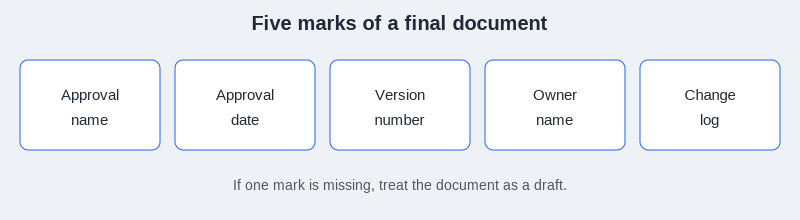
A final document carries five marks. First, an approval name. Second, an approval date. Third, a version number. Fourth, an owner name. Fifth, a short change log. If any mark is missing, treat the document as a draft.
Approval must come from the right person. A policy approved by its owner counts. A policy approved only by its author does not count. Name the approver on the cover page. Give the approver a role, not just a name.
Version numbers must tell a clear story. Version 1.0 means the first approved release. Version 1.1 means a small approved change. Version 2.0 means a major approved change. Never reuse a version number for different text. Never leave two files with the same version number.
How to mark drafts so they never reach the assessor
Remove draft watermarks before approval. Move old drafts to a separate folder. Keep only the final version in your evidence folder. Name the final file with its version number. For example, use a name like Access Policy v1.2.
If you must keep a draft for history, label it clearly. Put the word Draft in the file name. Put the word Draft on the cover page. Never link a draft from your evidence index. Your evidence index should point only to final versions.
What the change log must show
Each change log entry needs four facts. First, the date of the change. Second, what changed. Third, who approved the change. Fourth, the new version number. One line per change is enough. A long essay in the change log helps no one.
A change log also proves the document stayed alive. A policy with no changes in three years looks stale. A policy with dated, approved changes looks owned. Assessors notice the difference.
The check to run one month before the assessment
Open every document in your evidence index. Check for all five marks on each one. Check that each link opens the final version. Check that no draft file sits in the evidence folder. Fix every gap you find, then approve the fix.
Ask one person who did not write the documents to run this check. A fresh reader spots a missing approval fast. A writer reads what they meant, not what is there.
Sources
- CMMC Assessment Guide, Level 2.
- NIST SP 800-171 Revision 2.
- NIST SP 800-171A.
- Original diagram by PolicyCortex.
Next step
Want evidence tied to each practice from live systems? See how PolicyCortex collects it.