Home / Article
How Do We Show a Control Stayed in Place All Year?
One good day of proof will not convince an assessor. A control that worked in January may have broken in June. Your evidence must cover the full period, not one lucky day.
Cybersecurity Maturity Model Certification (CMMC) Level 2 uses the requirements in NIST SP 800-171 Revision 2. NIST means National Institute of Standards and Technology. CUI means Controlled Unclassified Information. An assessor checks each practice against that requirement set. The program rule is Part 170, Title 32, Code of Federal Regulations (CFR).
What an assessor wants to see
An assessor wants proof that a control kept working over time. A single screenshot proves one moment only. A set of dated records proves a habit. That habit is what the assessor is really testing.
NIST SP 800-171A gives assessors three methods. Examine means reviewing records and documents. Interview means talking with staff who run the control. Test means exercising a control under set conditions and comparing the result with the expected result. Dated samples help all three methods. Records show the pattern. Staff can describe the same pattern. Tests can repeat it.
Build a timeline, not a pile
Pick a sample rhythm for each control, then stick to it. Monthly samples fit controls that change often, such as access reviews. Quarterly samples fit slower controls, such as backup restores. Write the rhythm down in your evidence index. An assessor should see the plan before the files.
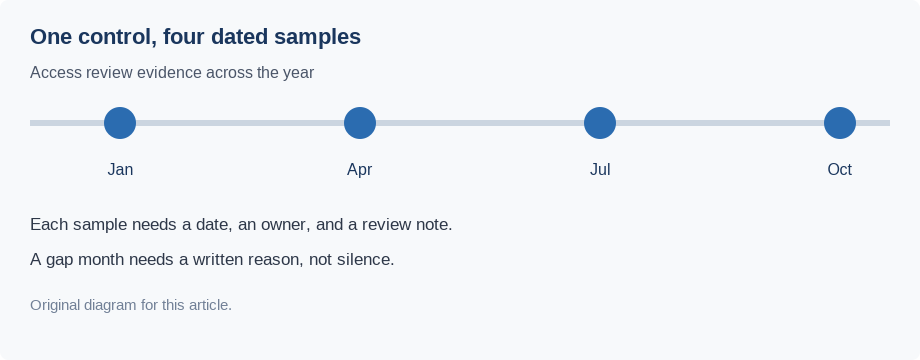
For each sample, file four items together. First, the record itself, such as a config export or a review sheet. Second, the date it was taken. Third, the name of the person who took it. Fourth, a short review note that states what was checked and what was found. A file with no date and no owner looks like a draft, even if the content is right.
Use a simple naming pattern that keeps dates visible. Put the practice number first, then a short description, then the date. Keep the same pattern for every sample. When the pattern breaks, an assessor will ask why.
What to do about gaps
A missing month is not fatal if you explain it. Write a short note that states the reason for the gap. State what you did to close it. File the note with the samples around it. Silence about a gap looks worse than the gap itself.
If a sample shows a failure, keep it. File the fix beside it, with its own date. Show the recheck that proved the fix worked. That chain proves the control was watched, not just filed.
A worked example
Take an access review control. File a review in January, April, July, and October. Each review lists who had access, who approved it, and what changed since the last review. Each review is signed by the reviewer. In the assessment, the assessor can trace access across the year in four steps. No single review carries the whole case. The set does.
Interview proof should match the same story. Ask staff to describe how often reviews happen and who signs them. If staff describe a different rhythm than your files show, fix it before assessment day. Assessors notice that mismatch fast.
Check before you submit
Open your evidence index and read down one control at a time. Ask three questions for each sample. Is the date clear? Is the owner named? Does the review note state a result? If any answer is no, fix that sample now. A complete timeline takes work to build. It also removes the hardest question an assessor can ask, which is what happened between your samples.
Next step
PolicyCortex collects evidence from live Azure configuration using 33 collectors. The collectors read conditional access, diagnostic settings, Defender posture, backup, and firewall. The evidence is evaluated against NIST 800-53 and NIST 800-171. It supports re-verification after remediation. It generates SSP, SAR, and POA&M output from collected evidence. SAR means Security Assessment Report. SSP means System Security Plan. POA&M means Plan of Action and Milestones. PolicyCortex is strongest in commercial Azure, and AWS is covered. Start at https://policycortex.com.
Sources
- NIST SP 800-171 Revision 2, Protecting Controlled Unclassified Information in Nonfederal Systems and Organizations, National Institute of Standards and Technology. https://doi.org/10.6028/NIST.SP.800-171r2
- NIST SP 800-171A, Assessing Security Requirements for Controlled Unclassified Information, National Institute of Standards and Technology. https://nvlpubs.nist.gov/nistpubs/SpecialPublications/NIST.SP.800-171a.pdf
- 32 CFR Part 170, Cybersecurity Maturity Model Certification (CMMC) Program, U.S. Department of Defense, eCFR. https://www.ecfr.gov/current/title-32/subtitle-A/chapter-I/subchapter-G/part-170