Home / Article
CMMC Boundary Protection When the Firewall Itself Is the Flaw
Cybersecurity Maturity Model Certification (CMMC) Level 2 rests on National Institute of Standards and Technology (NIST) practices. Two practices meet in this story. One guards the boundary, and the other fixes flaws on time.
The Cybersecurity and Infrastructure Security Agency (CISA) added four flaws on October 14, 2026. They joined the Known Exploited Vulnerabilities (KEV) catalog that day. Federal civilian agencies faced an October 17, 2026 due date in reporting.
The boundary device is the finding
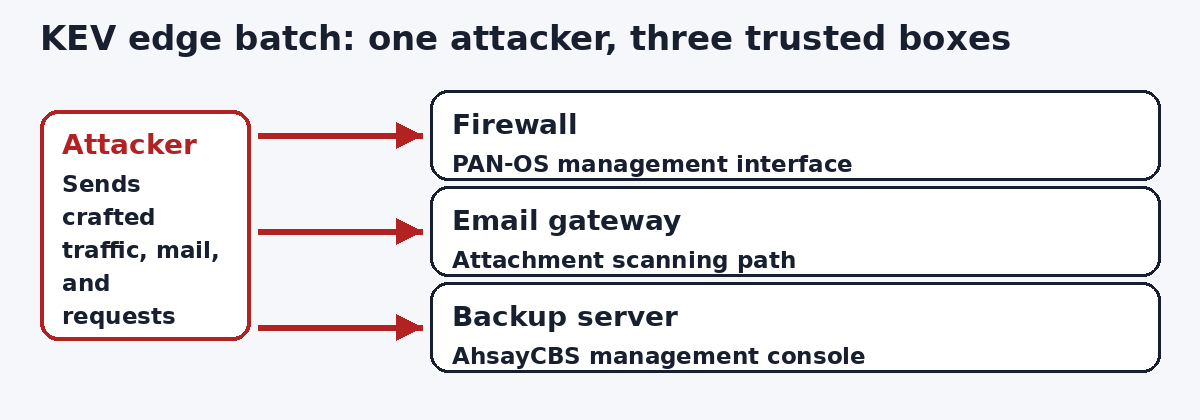
Practice SC.L2-3.13.1 covers boundary protection for organizational systems. Your firewall is the tool that delivers that practice. CVE-2026-0322 sits in the PAN-OS management interface itself. An authenticated attacker can run code as root there, scoring 8.6.
An assessor will ask a hard question here. How do you protect a boundary with a compromised guard? The honest answer starts with the fixed build record. It also includes who could reach the management interface.
CVE-2026-76519 raises the same issue for mail flow. Cisco Secure Email Gateway scores 9.8 on this flaw. A crafted attachment reaches root without any login. Mail crosses your boundary through that gateway every day.
The backup server inside the scope
CVE-2026-105133 breaks authentication in Ahsay AhsayCBS. CVE-2026-105134 adds command injection in the same product. Together they hand an attacker SYSTEM access.
Backup servers often hold Controlled Unclassified Information (CUI) copies. That puts the server inside your CMMC scope, not beside it. Scoping guides sometimes treat backup tools as background systems. This chain shows why that treatment fails.
Evidence an assessor can test
Practice SI.L2-3.14.1 requires timely flaw correction. Timely needs a record, not a memory. Keep the vendor advisory next to the patch ticket. Keep the before and after build numbers together. Keep the compromise check result with the same record.
Ahsay adds a warning worth keeping in the file. Its earlier patches did not fully close these flaws. A ticket closed on the first patch proves little. The record must name hotfix 10.3.4.45 or 9.15.2.70, by version line.
PolicyCortex does not patch these appliances. Your administrators apply each vendor fix themselves. PolicyCortex helps keep the evidence tied to each practice.
What to do this week
Find every in scope firewall, gateway, and backup server. Match each build to the vendor fixed version. Close the gap, then save the proof in one place. Note any system you cannot patch, and say why.
Sources
- CISA alert, CISA Adds Four Known Exploited Vulnerabilities to Catalog, October 14, 2026. https://www.cisa.gov/news-events/alerts/2026/10/14/cisa-adds-four-known-exploited-vulnerabilities-catalog
- CVE-2026-0322 record, CVE Program. Palo Alto Networks advisory at https://security.paloaltonetworks.com/CVE-2026-0322
- CVE-2026-76519 record, CVE Program. Cisco advisory cisco-sa-esa-afw-zqYJkjxp.
- CVE-2026-105133 and CVE-2026-105134 records, CVE Program. Huntress report at https://www.huntress.com/blog/ahsaycbs-flaws-exploit
- Original diagram by PolicyCortex.
Next step
Want flaw records tied to each CMMC practice without a spreadsheet hunt? See how PolicyCortex links evidence to the practice.