Home / Article
NGINX 9.2 Flaws Test Your CMMC Flaw Remediation Evidence
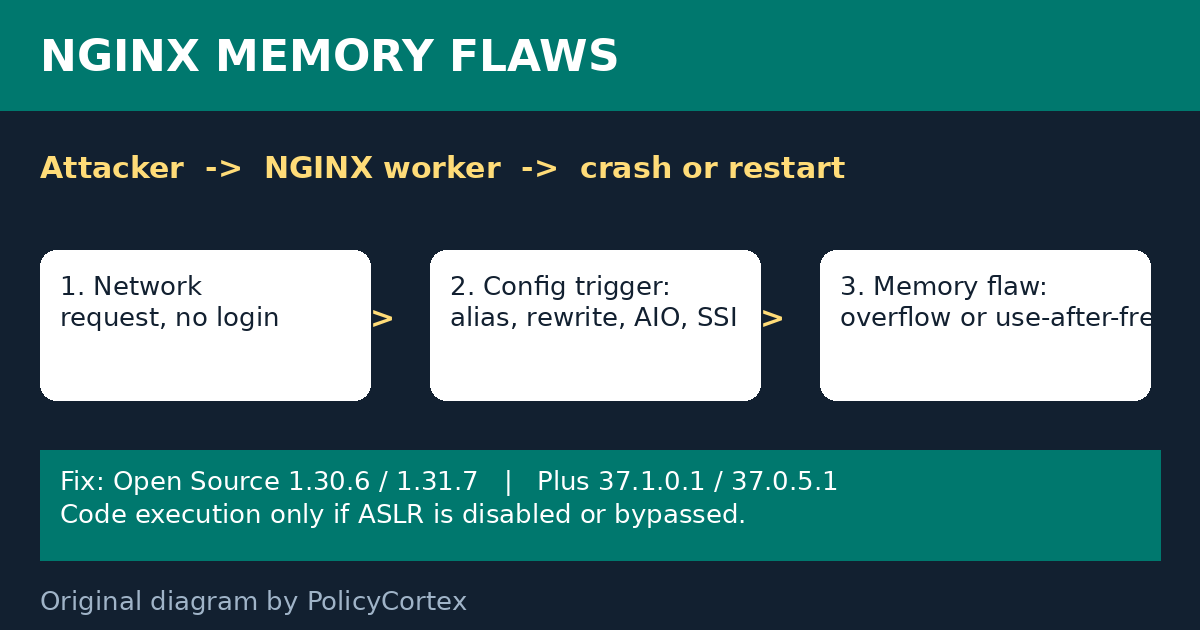
A patch without a dated record is a claim, not evidence. F5 handed teams a clean test case for that rule.
On October 14, 2026, F5 published out-of-band security notification K000163408. It fixes three NGINX memory flaws. F5 scores each flaw 9.2 under Common Vulnerability Scoring System (CVSS) version 4.0. NGINX itself rates them medium. Note both scores in your file. An assessor will ask why they differ.
The three flaws
Common Vulnerabilities and Exposures (CVE) is the public record system. All three flaws are unauthenticated and network reachable. None needs user interaction. All three carry high attack complexity.
- CVE-2026-15176: heap buffer overflow in the core HTTP module, triggered by alias and rewrite directives using $request_filename.
- CVE-2026-97205: use-after-free flaw, needing asynchronous file input/output (AIO) with Server Side Includes (SSI) virtual includes.
- CVE-2026-93479: heap buffer overflow from premature regex map capture references and certain non-cacheable variable expressions.
The main impact is a worker process crash or restart. Code execution needs Address Space Layout Randomization (ASLR) disabled or bypassed. Keep ASLR on. Patch anyway.
Fixed builds are NGINX Open Source 1.30.6 and 1.31.7, and NGINX Plus 37.1.0.1 and 37.0.5.1.
What the evidence file should hold
Flaw remediation evidence answers four questions. Which systems were affected. When the flaw was found. When each system was fixed. What the re-scan showed.
Build the file in that order. Start with the NGINX inventory, version per server. Add the config trigger check for each server. Record the upgrade date per server. Close with the dated re-scan result.
No confirmed exploitation was reported through October 20, 2026. The Cybersecurity and Infrastructure Security Agency (CISA) Known Exploited Vulnerabilities (KEV) catalog does not list them. Do not let a quiet week slow the file. The notice itself is public, so attackers can read it too.
Sources
- F5 security notification K000163408, NGINX Open Source and NGINX Plus vulnerabilities, October 14, 2026.
- CVE-2026-15176 record, CVE Program.
- CVE-2026-97205 record, CVE Program.
- CVE-2026-93479 record, CVE Program.
- Original diagram by PolicyCortex.
Next step
Want flaw remediation evidence linked without chasing spreadsheets? See how PolicyCortex collects it from live systems.