Home / Article
What Plex2Shell Teaches About CMMC Flaw Remediation Evidence
Your patching record is only as good as its proof. Plex2Shell just showed why.
On October 20, 2026, CISA added four Plex Media Server flaws to its Known Exploited Vulnerabilities catalog. CISA is the Cybersecurity and Infrastructure Security Agency. The catalog names flaws with evidence of active exploitation.
The four flaws are CVE-2026-96652, CVE-2026-96654, CVE-2026-96655, and CVE-2026-96656. (CISA alert) Chained together, they give an attacker code execution with no login. Fixed builds are 1.43.3.10861 and later. (CVE-2026-96656 record)
What the practice asks for
CMMC practice SI.L2-3.14.1 comes from NIST SP 800-171. It asks you to identify, report, and correct information and system flaws in a timely manner. NIST SP 800-171A is the assessment guide. Its objects include flaw reports, patch records, and scan results.
An assessor does not want your word that you patched. They want dated records that show the flaw, the fix, and the check after the fix.
The four records that satisfy it
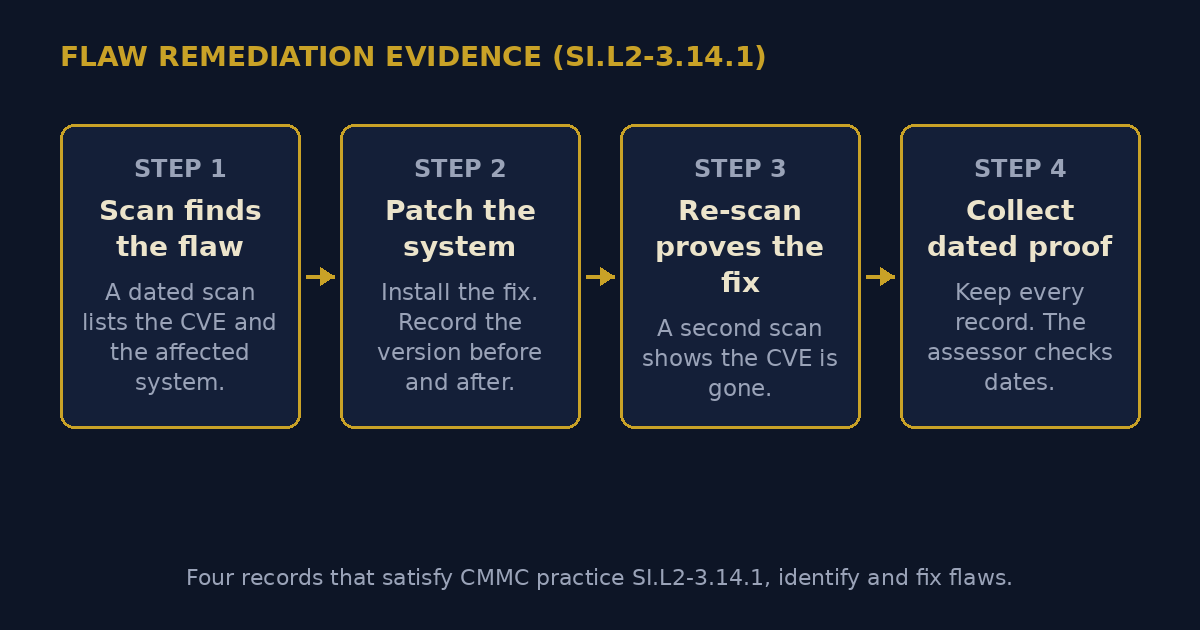
First, the scan that found the flaw. It names the CVE, the affected system, and the date. For Plex2Shell, that means the four CVE numbers and the build you were running.
Second, the patch record. It names the version before and the version after. 1.43.3.10861 is the fixed build. An earlier 1.43.3 build does not count.
Third, the re-scan. It shows the flaw is gone from the live system. A ticket marked done is not proof. A clean scan is.
Fourth, the compromise check. Plex says an older server that faced the internet should be treated as possibly compromised. If your network had one, the incident record belongs in the evidence set too.
Why chained exploits change the order
Each Plex2Shell flaw scores medium or high alone. Ranked by single scores, a team patches 9.0 flaws first and leaves this chain running.
Assessors test the control, not the list. The assessment guide lets them check that you remediated flaws in a timely manner. A medium scored flaw with active exploitation is more urgent than a critical one with none.
Write that rule into your process. Exploited flaws go first, whatever their score.
What to do this week
List every internet facing system you own, not just the servers you think about. Note the version of each one. Compare the list against the CISA catalog.
For each exploited flaw you find, collect the four records above. Date everything. An assessor trusts records with dates more than records without them.
Sources
- CISA Adds Six Known Exploited Vulnerabilities to Catalog, CISA, October 20, 2026. https://www.cisa.gov/news-events/alerts/2026/10/20/cisa-adds-six-known-exploited-vulnerabilities-catalog
- CVE-2026-96656 record, CVE Program. https://www.cve.org/CVERecord?id=CVE-2026-96656
- NIST SP 800-171A, Assessing CUI Requirements. https://nvlpubs.nist.gov/nistpubs/SpecialPublications/NIST.SP.800-171Ar3.pdf
- Original diagram by PolicyCortex.
Next step
Want flaw remediation evidence that pulls itself from your live systems? See how PolicyCortex collects it on Azure.