Home / Article
PwnEscape and the CMMC Isolation You Must Prove
CMMC asks contractors to protect system boundaries. PwnEscape shows a boundary can fail in the layer you rarely patch.
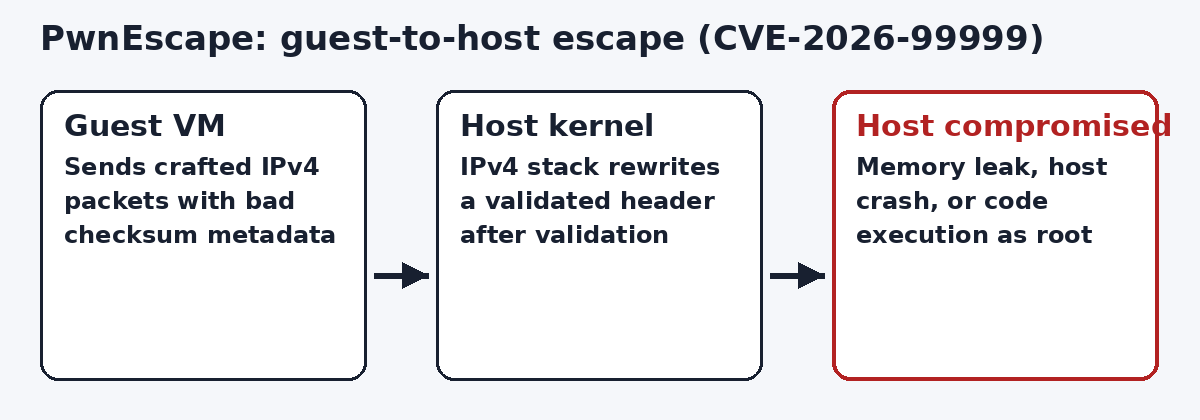
CVE-2026-99999 is a flaw in the Linux kernel's IPv4 stack. A guest virtual machine (VM) sends crafted packets with bad checksum metadata. The host kernel rewrites an already validated header. The guest escapes to the host: memory leaks, crashes, and code execution as root. The Linux kernel security team rates it 9.3, Critical.
The flaw is not in the hypervisor. It is in the host kernel under it. Patching guests does not fix it. Only a host kernel update does.
What CMMC asks for
The CMMC System and Communications Protection domain expects contractors to monitor and control communications at system boundaries. The System and Information Integrity domain expects contractors to identify, report, and correct flaws and malicious code.
Both practices need evidence. A boundary diagram that names the hypervisor is a start. Evidence that the hypervisor and host kernel are patched is the proof.
Affected kernels run from 2.6.27 through the fixed point releases: 5.10.272, 5.15.223, 6.1.190, 6.6.159, 6.12.113, 6.18.57, and 7.2.11.
The assessor's question
An assessor will ask how you keep the isolation between systems real. If your environment runs Linux virtualization hosts, the answer must include host kernel patching.
A practice that says "we patch our systems monthly" needs to show which systems. If the host layer is missing from the patch evidence, the practice is incomplete. PwnEscape is the example of why.
Contractors on cloud infrastructure can point to provider evidence. But the evidence must exist and name the host layer. A provider status page that says "all systems operational" is not patch evidence.
The flaw remediation record
For each affected host, record the current kernel version, the target fixed version, and the patch date. Record the verification after the reboot. Keep the kernel commit or vendor advisory reference.
That record satisfies two practices at once. It shows flaw remediation. It shows the boundary is maintained in the layer that enforces it.
What to do this week
Inventory every Linux virtualization and container host. Compare kernels against the fixed versions. Patch, reboot, and verify.
Then check your system inventory. If the host layer is not in it, add it. An assessor reads the inventory before asking anything else.
Sources
- CVE-2026-99999 record, CVE Program. Published October 15, 2026, updated October 19, 2026. CVSS 3.1 base score 9.3, Critical.
- PwnEscape technical writeup, pwn.ai. https://pwn.ai/blog/pwnescape
- CMMC Model, System and Communications Protection and System and Information Integrity domains. https://dodcio.defense.gov/cmmc/
- Original diagram by PolicyCortex.
Next step
Want patch evidence pulled from the live environment instead of a spreadsheet? See how PolicyCortex collects it on Azure.