Home / Article
What Do We File When a Control Uses a Shared Service Across Two Systems?
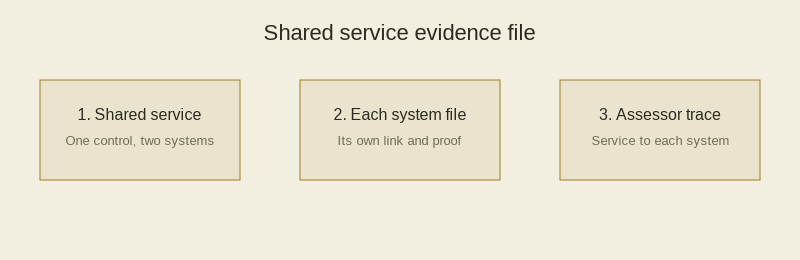
Two systems share one login service, and your evidence file gets messy fast. Each team points at the other team when the assessor asks for proof. The fix is to file the shared proof once, then link it from each system.
Cybersecurity Maturity Model Certification (CMMC) Level 2 draws its practices from NIST Special Publication 800-171 Revision 2. That publication sets safeguards for Controlled Unclassified Information (CUI). CUI is sensitive government information that needs protection, but is not classified. When a shared service protects CUI, both systems must show how it helps them.
Name the shared service first
Start with a one page service note. Name the service and its owner. List the two systems that use it. List the safeguards the service provides for each system. State the dates the service was in place.
Keep the note short and factual. An assessor should read it in two minutes. If the note needs ten pages, it is not a note yet.
A central login service is a common case. A central log store is another one. A shared backup service is a third. In each case, the service does part of the work for both systems.
File one proof set, link it twice
Do not copy the same proof into two files. Copying creates two versions that drift apart. Instead, file the proof once in a shared folder. Then add a short link note in each system file.
Each link note should name the shared proof. It should state which safeguard it supports for that system. It should state the date range the proof covers. It should name the person who can explain it.
For a login service, file the login records and the access rules. For a log store, file a sample log export and the retention setting. For a backup service, file a restore test record and the backup schedule. Each proof set should carry a date and a system name.
Show what each system still owns
A shared service never covers everything. Each system still owns its own part of the work. One system may set its own access roles. The other may set its own data rules. Write those owned parts down in each system file.
This split is what assessors check. They ask which part the service does. They ask which part the system does. If your file answers both, the interview goes fast. If it does not, the assessor must guess, and guessing slows the assessment.
NIST Special Publication 800-171A Revision 2 sets how assessors check safeguards. They examine records, interview staff, and test controls. Your shared service note must match what staff say. Brief both teams on the same note before the assessment.
What to do this week
List every service shared across your systems. Write one service note per service. Add a link note to each system file. Check that no proof set exists in two places with different dates.
Sources
- NIST SP 800-171 Revision 2, National Institute of Standards and Technology.
- NIST SP 800-171A Revision 2, National Institute of Standards and Technology.
- 32 CFR Part 170, Cybersecurity Maturity Model Certification Program, Code of Federal Regulations.
- Original diagram by PolicyCortex.
Next step
Want shared service proof linked to each practice? See how PolicyCortex collects it from live systems.